
Introduction
Some games are recognizable from a screenshot before you even know their name. Apotheon is one of them.
Released by independent studio Alientrap in 2015, Apotheon is a 2D action RPG and platformer built around ancient Greek mythology. The basic premise sounds suitably mythological: humanity has been abandoned by the Olympian gods, and a mortal hero named Nikandreos must ascend Mount Olympus, confront them, and seize their divine powers in an effort to save mankind.
But the story isn't what makes Apotheon immediately distinctive.
It's the fact that the entire game looks like an ancient Greek vase has started moving.
Black-Figure Art, Brought to Life
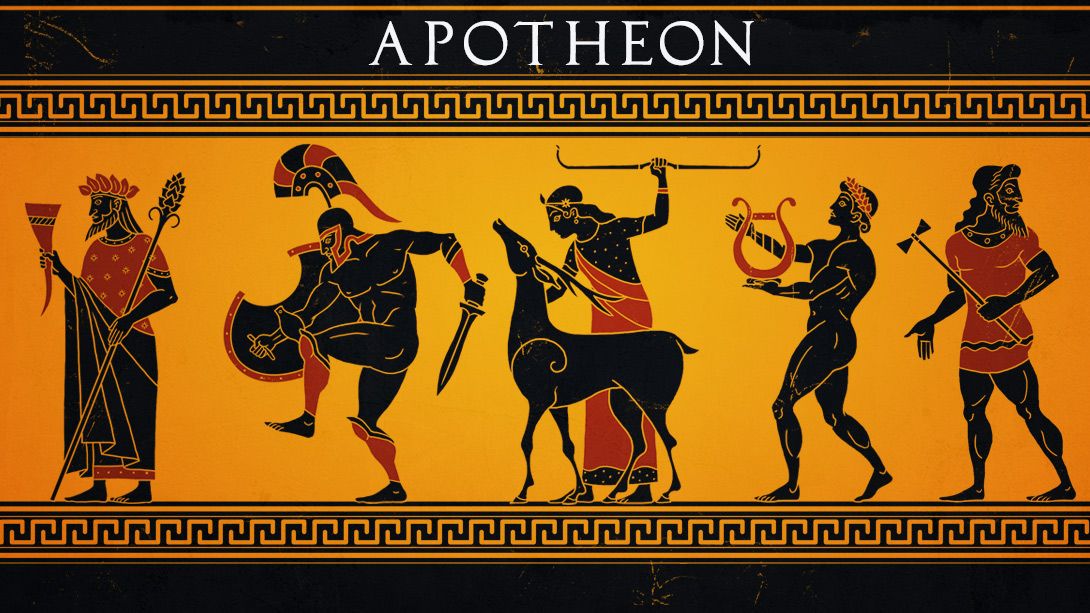
The game's visual identity is based heavily on black-figure pottery, a style associated with ancient Greek ceramics in which figures were painted as dark silhouettes against the reddish or ochre surface of the vessel.
Characters in Apotheon follow the same visual language: dark, flat figures bordered by geometric patterns and surrounded by the colors and textures of painted pottery.
This wasn't simply an aesthetic pasted over an otherwise conventional game.
Jesse McGibney, Apotheon's co-designer and artist, explained that the team initially considered a concept involving “space Greek mythology,” but eventually realized that Greek mythology itself was enough. Once that happened, black-figure pottery became a natural fit for both the setting and a 2D platformer.
The result is something that simultaneously looks thousands of years old and completely at home on a modern screen.
Adapting Ancient Art to a Video Game
There was one problem: an actual Greek vase was never designed to function as a video-game level.
Traditional black-figure artwork generally focuses on people, gods, animals, and individual scenes. A game needs much more: buildings, caves, forests, platforms, doors, pathways, foregrounds, backgrounds, and enough visual separation for the player to understand where they can move.
The developers therefore couldn't simply reproduce pottery literally.
McGibney explained that the team expanded the visual language using geometric shapes and patterns associated with the original artwork, allowing them to build environments that still felt like part of the same artistic world.
That distinction is part of what makes Apotheon interesting from a design perspective.
It isn't just imitation.
It's translation.
The developers took the rules of an ancient visual medium and asked what those rules would look like when applied to an interactive one.
Mythology as More Than Decoration
The same approach extends beyond the graphics.
Apotheon doesn't simply borrow Zeus, Hera, Artemis and other recognizable names because Greek mythology looks cool. The team worked with classical scholar Maciej Paprocki, who contributed to the narrative, characters, dialogue, and mythological research.
Paprocki explained that the game's story combines and develops elements including Hesiod's succession myth and the myth of the Five Ages of Man.
The setting imagines the end of humanity's final age: Zeus has decided to separate the gods from mortals, divine influence is withdrawn from Earth, and the human world begins collapsing as the natural systems once sustained by the gods disappear.
Against that backdrop, Nikandreos begins moving upward—literally and metaphorically.
Becoming the Apotheon
Even the title connects directly to that progression.
According to McGibney, Nikandreos ultimately takes the gods' powers and becomes divine himself. The team chose Apotheon in reference to apotheosis, the idea of ascending or being elevated to divinity.
Paprocki describes an “apotheon” as someone elevated to a state of godhood.
That makes the title essentially a description of the player's journey:
mortal → challenger of the gods → something approaching a god himself.
It is a satisfying example of a game's name, visual identity, mythology, and progression all reinforcing the same central idea.
A Game That Looks Like Its Subject
Plenty of games use Greek mythology.
What makes Apotheon memorable is that it doesn't stop at putting Greek gods into a familiar visual format. The mythology influences the story, the architecture, the weapons, the characters, and most obviously the fundamental way the world is drawn.
Contemporary reviews repeatedly singled this out. Destructoid praised the black-figure aesthetic and the way the game commits to making its environments feel like painted ancient surfaces, while GameSpot described the experience in almost archaeological terms because of how thoroughly the game adopts that visual vocabulary.
More than a decade after its release, screenshots of Apotheon still don't look like screenshots of much else.
And for an independent game, that's an achievement worth remembering.
Why Apotheon Is Here
There is also a much simpler reason this felt like an appropriate first article for this site:
Apotheon. ApotheonAI.
The connection is mostly in the name, but discovering a game that took something ancient, reinterpreted it through modern technology, and ended up with such a distinctive identity felt fitting enough to earn the first real post here.
Sometimes that's all the excuse a first blog post needs.
Sources
The factual material in this article is based primarily on Alientrap's official Apotheon materials, an interview with artist Jesse McGibney, an interview with classical consultant Maciej Paprocki, and contemporary coverage of the game.